What A Wonderful Week :(

     i've just had one of the worst weeks I've ever experienced and we're only halfway through! Wooo! Tai and I had a really lovely, totally wonderful, not stress inducing at all, and completely calming conversation about this goofiness and it totally didn’t make my blood boil and fill me with immense rage. I’m at a loss for words with sillines I’ve had to deal with and it’s honestly burnt me out. I’m tryin not to let this fatigue get in the way of the project. So here’s a progress update. 

    Painting is. . . Slow. I haven’t gotten much progress into it with the immense amount of homework I’ve had this week. The canvas’s from Amazon arrived and they were smaller than expected, so on Friday I’m going out to Micheal’s and getting the large one needed. Friday will be my designated day to finish all the paintings. Remember how I mentioned painting is a form of therapy for me? We’ll it’s really gonna have to come in clutch this 

    I messaged good ol’ Jimmy G (Jim Guarasci) the executive producer of BECON about checking out equipment with a list of what we potentially might need! Luckily, he said it should all be available on Tuesday 21st (which is the day after we come back from STN) for us to check out. This is perfect with filming set to be during spring break.

    Filming has been set to happen this weekend, but only the second half of the opening. But wait, I haven’t checked out from BECON! Good thing is, some of the equipment we need is available in the CBTV closet, which won’t  be open for spring break but is open for this weekend so we plan to snag that stuff. Tai is going away for spring break so filming at least the second half this weekend will help us avoid having to delay any more progress.

    We've done a lot to prepare for this so nothing theoretically should go wrong, but I'm keeping my fingers crossed.


Painting As A Form Of Therapy

     A part of me felt the need to procrastinate the painting process. I was exhausted from the responsibilities the week had bestowed upon me and all I wanted to do was lay down on something comfortable and turn my brain off. I knew at some point I had to get started. So while procrastinating some other class's homework, I prepped the paint, grabbed a cup of water and a brush, and started painting. 

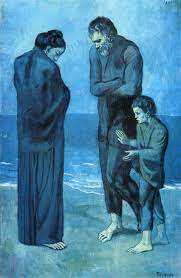
Pablo Picasso: The Tragedy
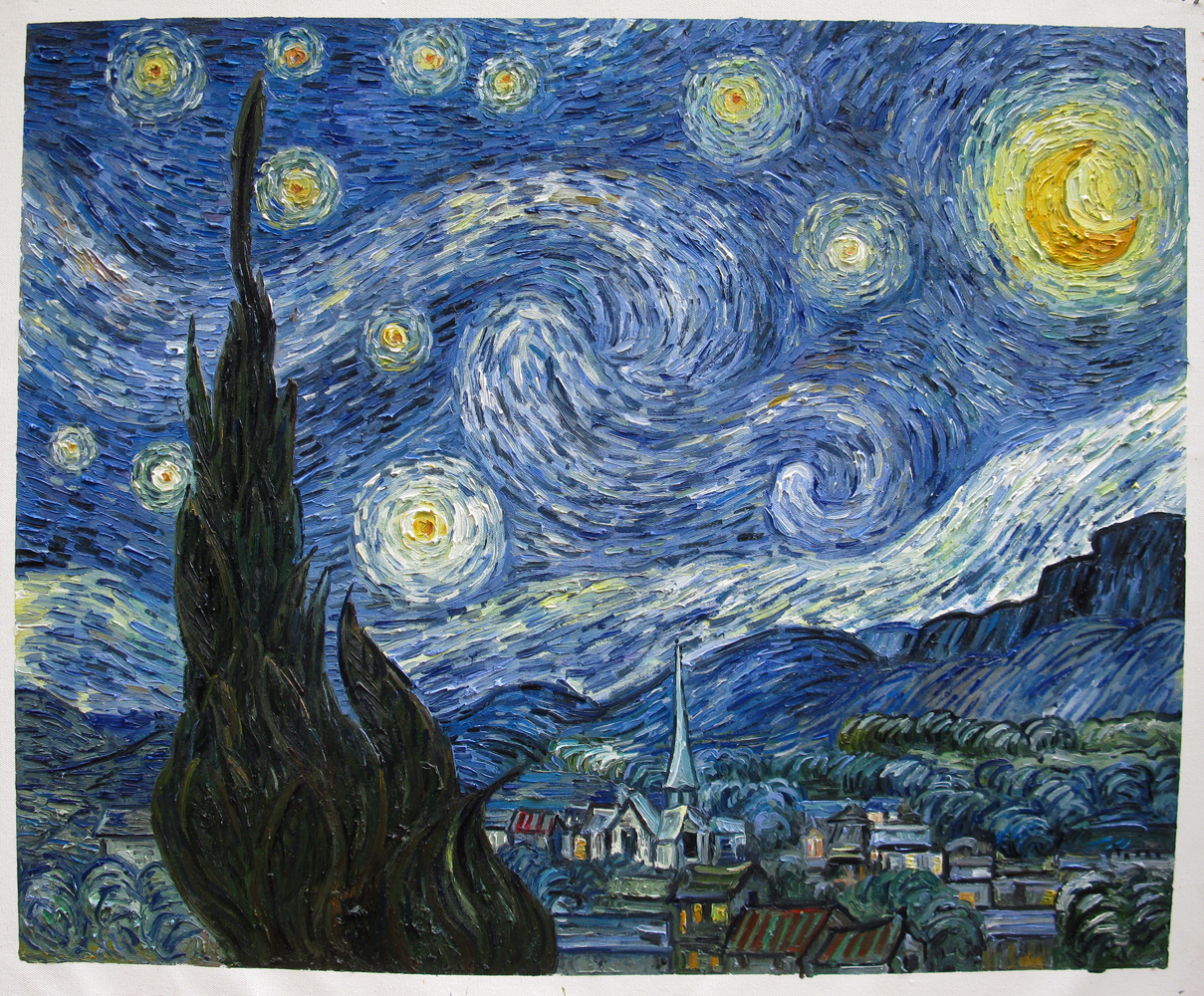
    I forgot how much I loved the hobbie. It's been a couple months since I had really sat down to paint for leisure, so it took me by surprise how theraputic it is. I played a youtube video for background music and immersed myself in the artform. I stuck with mainly cool tones for the paintings since a lot of them are supposed to reflect the state of mind of the old artist, but I did make a few warmer colored paintings that can be both used for the old artists earlier paintings that may be up on his wall, and some of the new artists paintings. The cool blues I feel help to associate the old artist with a negative state of mind. I took inspirations from Picasso's blue period and Van Gogh's Starry Night. Picasso mostly used blue's during a period of immense depression which I feel helps to had subtext to the state of mind of the old artist. Van Gogh's Starry Night also uses a large amount of blue tones, and the style of showing prominent strokes I feel helps to demonstrate how meticulous these artist may be.

Vincent Van Gogh: Starry Night

Sam Perez: Silly Little Paintings


    We still have a long way to go with the amount of paintings we need to make, but at least we already have a starting point. I'm excited to paint some more!

Silly Little Issues

     So Tai and I came to a unfortunate stand-still on the project. The plan initially was to film during all of spring break after we come back from the STN trip. The funny thing is that Tai is now going to tour colleges over all of spring break so they can no longer film during those days. There is no set date yet of when she leaves and comes back so organizing filming days has become a bit of a struggle. I honestly felt quite unsure about how we were going to finish this project, now having been presented with this information, so I consulted my partner, and frequent collaborator who did it last year and he suggested two options:

Tacos Mode
    He at first said (and this is gonna sound real weird) "turn on tacos mode." Now you may be thinking, what is tacos mode? For context, during winter break, my partner and I filmed an entire short film (named "This, That, and Tacos") over the course of 5 days. How did we do this? Early start times and late end times. Our filming schedule was the equivalent to a 9-5 job, It wasn't "meet up for 2 hours and see what we can get done." While efficient, this method took a lot of energy out of us, and if this is the trajectory the film opening is going to go in, I need to mentally and physically prepare. Also, without set dates for tai's unavailability, it could potentially mean I'd have to lead at least half of the filming all on my own, which while it isn't my first time leading a project on my own, I wouldn't call myself a proffessional.

Skills USA Mode
    Option #2 and the more demanding option would be to "turn on Skills USA mode." Again for context, my partner and I also worked together on a competition called Digital Cinema, as part of the general Skills USA competition, which is basically yet another TV competition I'm participating in. The gist of Digital Cinema, is that we have 48 hours to create a short film that can be up to 5 minutes, that follows the prompt given to us at the start of those 48 hours. This was no longer a 9-5. This meant working non-stop as quickly as possible, and for as long as possible, avoiding any unnessary(this means all) breaks. The only real downtime we got was a grace period of about 6 hours for sleep, just sleep. If the first option sounded bad, this option is inhumane. . . 


 . . . but not impossible. I mean, if I've done this before, theoretically, I can do it again. And it would cut back the amount of time taken up in production, so we aren't as strained in the last two weeks of the project. The main downside is, I might lose my sanity in the process (ok that's a bit dramatic but the point still stands!). I think if I go about this in such a way that I can still leave room to breath during filming for both myself and the actor I'd be working with, than I think I can do it. 

Looking At A Calendar

     I’ll admit, I don’t typically like scheduling. I'm the type of person that once I flesh out the idea, I want to jump right in. However I see the importance of scheduling and given the situation Tai and I are in, I decided to actually look at a calendar. At first, I was intimidated. Looking at the quantified number of days we have left to finish the opening sparked some unwelcomed anxieties. Questions about how early we can film, how much time we have to edit, and whether or not we'll even be able to get together for production began to plague my mind. So I started with the most recent.

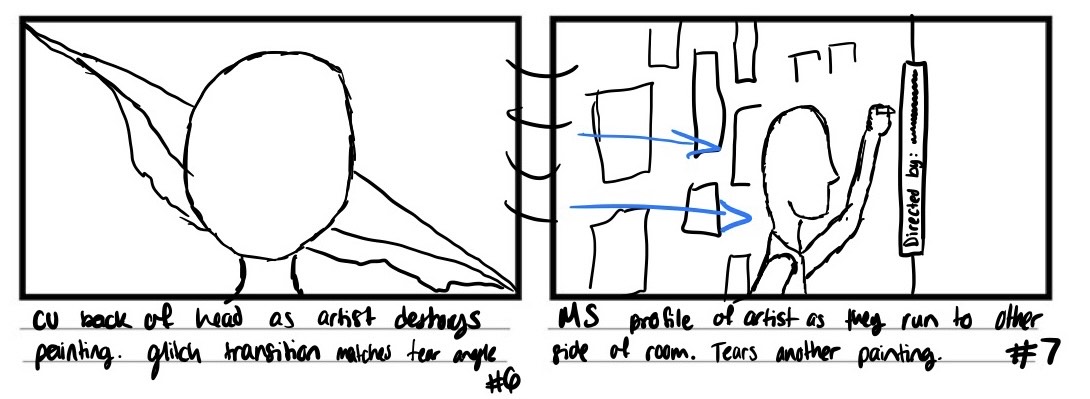
    During my economics class (this time I finished the classwork) I spent a good 40 minutes finishing the storyboard, labeling shots, setting up the goals of filming days, and setting up an shot list order. The storyboard helped to put into perspective how many shots we truly need for the opening (we only need 25). This not only makes the filming process feel more manageable, it will also help us in editing, knowing exactly how many video clips we need in the timeline and exactly where each clip will go.  

action v cut
    I labeled every shot in the storyboard with both a description and a number. 
The description should help with communication on set as well as with remembering the point of each shot. During the music video project, production was slightly disorganized and part of the reason why was because the storyboard was hard to interpret by the rest of my team.  I created it so I understood it pretty well, but that wasn't the case with my fellow group members. I would often get asked question about how to frame the shot, what exactly is happening in it, and what kind of movement is the camera doing. This made me realize that if i had given a shot descriptions, a lot of the issues with communication could've been avoided, and filming could've gone smoother, which is why this time I'm not taking any chances. 

    The numbering of each shot at first was just to get an idea of how many shots there were in total. Since I would draw the same shot back to back, I needed a way to destinguish between frames that describes actions, and frames that described cuts. However, while organizing the order of shots list, the numbers ended up being a really easy way to organize each clip without having to write the full description. This will definitely help in organizing the way we film, especially if multiple shots can be done with the same setup. The filming schedule is also extremely helpful because it give us a good idea of the goals we need to accomplish for each day of filming, as well as gives us an idea of how long each day will last. It also helps since we have a friend of ours acting so scheduling with him will be easier since we can give him the full scope of what we're doing, from which days and times we'll need him and what he'll be doing throughout the opening.

I've checked out from BECON-TV before
    This week, we can get started on making the props. I can begin painting on friday with the supplies I have, and Tai can begin working on newspaper props. I have already gotten the paint and have some leftover mixed media paper I can use while I wait for the items ordered online to arrive. Tai has 5 small canvases, a bit of paint, and some paintbrushes to she can use to make some of the other paintings. 

    Next week, we can finish props, I can make the fake blood, we can find the clothing each character each character will wear, and we can secure the actors. The week before we leave for STN (Student Television Network competition for our TV program at school) We can check out equipment from BECON-TV a wonderful resource for all things production (they have everything from cameras, tripods, and array of lighting equipment, and even props).


The full schedule
 

Translating Pictures to Words

     A good friend once told me that a good script should also be a good read, which is why they prefer not to include directions such as shots, cuts, or behind the scenes actions in it in order to avoid breaking the immersion. Now I agree, a script should be a good read. But I WANT TO WRITE THOSE DIRECTIONS! Whenever I have an idea I like, I always try to write it down somewhere before I forget it. Which is why, whenever I write a script, and I'm immersed in my own train of ideas. I always get the urge to write down the directions for those ideas.

    For example, in every script I've written for informational videos,  I always write down the composition of the shot, the movement of the camera, and the edits being made. It helps me get a better sense of the whole this way. I can translate everything that is going through my mind into words. Which is why it pains me whenever I try to write a script without those directions. I can only do so much describing the environment and actions of the characters. I need to describe exactly what the camera is showing, and how it is showing it to us. What if I forget it? What if I look back at the script and can no longer visualize the film in the way I did before. What if I can't visualize it at all. 

    Now there are solutions to this problem. I can always create a shot list to refer to while filming, that way I still have the shots written down somewhere. So for this script, I decided to challenge myself, and avoid writing any sort of behind the scenes directions, what is read is what the audience knows. I'll admit, this was quite the challenge for me. I ended up splitting up the time between writing a script and writing a shot list since the ideas were flowing at the same time. However I think I've come up with something that works pretty well as a stand alone read. 

Take A Gander


Scheduling Is Hard When You're A Busy Person

     While many people may be starting to film their projects within the coming weeks, Tai and I are very much so stuck in the rut of trying to find an adequate amount of time to do so. For context, the level of work we have (specifially for a class/club we're in) takes up a majority of our time already.

    For both of us, there are a set list of responsibilities we have. We're both participating in a competition that has us practicing for 8+ hours every weekend. Thats almost a whole day we could be using to film. Additionally, we're both part of a class that has us making an almost weekly 20 minute show. While Tai has to make a video almost every week, I am one of the people actually producing the show so both of our time is taken up by either video production or having to manage everyone making a video. Remember that competition I mentioned before? Yeah for about five days we go all the way to Long Beach, California. and thats about 19 days away from today. So that almost a whole week where we can't film at all. Keep in mind this does not include the regular school work we both have. 

    So heres the solution. We'll spend this time heavily planning the film, making sure we acquire/make every prop, making sure we know where and when we're filming, and making sure we have actors, and equipment secured. We will also make sure exactly which shots we need to get and how we need to get them, making sure we have a storyboard, shot list, action list, and script. Actual production. will take place during spring break. Neither of us have plans of traveling with family and it is the only true extended free time we have. Spring break cuts it close to the deadline of the project, which is why we're heavily relying on making sure the planning is solid enough to speed up the production process.

I really hope this works.

Making My Life Harder

    I have a love hate relationship with storyboarding. For starters. I love how useful they can be in terms of providing a visual aid for the film. However, I hate how tedious it can get especially when there are certain elements of the background that are important and therefore need to be drawn. I love how easy it can be to film when I already have a storyboard but I hate how easy it can be to underestimate how much time a shot will take up depending on how many actions are in it. So when creating the storyboard for this opening, I was faced with the question of how detailed do I need it to be?

    I settled for a middle ground… initially. I often underestimate my ability to rationalize overworking myself. Story boards don’t need to be drawn perfectly but in my eyes, it it’s not perfect, it’s not good enough. Now I’m starting to sound like the characters in the opening. At one point. I took a break. There’s was a YouTube video on my feed that related to the opening. It was called “Why Artists Are Never Happy”. It caught my eye so I watched it, and it helped provide some insight into the character of my film opening. What if the old artist never did receive that first place award. Or maybe they did but they were so  blinded by their own perfectionism that they couldn’t even see it as a first place award. I thought the concept of seeing what isn’t there was cool. And I was reminded again of Black Swan and how the main character began hallucinating herself becoming a swan as the
y become more and more obsessed with perfecting the role. It got me thinking, what if the old artists paintings had all won first place? What if it was solely their own inner turmoil that kept them feeling inadequate?

    This ended up helping the overall development of the storyboard seeing as I could use little bits of set design to give away more information about the charcter without expicitly saying too much. I ended up being able to finish the first minute and a half or so of the film openings story board. Whilst there are a few set details that still need ironing out, at least we have the basics down. Ironically this also helped sooth a bit of the perfectionist attitude I had towards creating the storyboard, which ultimately helped me move foward at a faster pace.

FILM OPENING

 Here it is in all it's glory